
Deception - in War & in Peace
$2.99
$9.99
About
1. The Author’s Preface
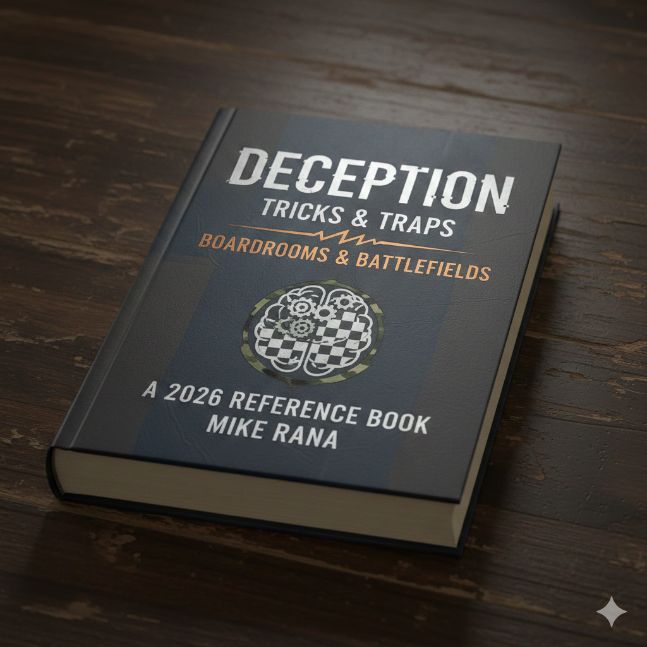
DECEPTION
In War & Peace
represented by Boardrooms & Battlefields
A 2026 Reference Book
Over the past few decades, modern technology —radio, TV, air travel, and satellites—has woven a network of communication that puts every part of the world in almost instant contact with the rest—David Bohm.
Success isn't about how hard you fight. It's about how many traps you avoid—and how many you set—Mike Rana
This book is for War & Peace, represented by the boardrooms and the battlefields
1. A Sincere Welcome
I’m truly delighted to see this book in your hands—a treasure trove of things you probably didn’t know, just as I didn’t. As you may have guessed, I am a former Indian Air Force Group Captain with a background in both the military and corporate worlds. In my professional journey, I have observed that DECEPTION is omnipresent and applies universally in our professional lives. Understanding this hidden attribute can turn you from a loser into a winner, while ignorance about it will lead you to oblivion.
How I wish I had come across such a book sooner in my career. Even though I’ve been fortunate to receive many awards from the Indian government as a VSM recipient in the Indian Air Force and have excelled in every exam I’ve taken, I believe this book could have broadened my perspective even more, making my journey feel less daunting and more fulfilling.
I truly hope this book can make things easier for aspiring engineers and professionals, with a seamless journey. It's a bit sad that it might be kept away on HR's private shelves, out of reach for those who could gain so much from its valuable lessons—lessons that often aren’t covered in MBA programs or the military's staff colleges.
This book is crafted for everyone interested in current affairs, history, politics, technology, diplomacy, international studies, war strategy, and business management. Whether you're engaging on LinkedIn or X, you'll find valuable insights here designed to inform and inspire.
As many defence officers retire early and begin new chapters in their lives, it's helpful to provide them with a warm, honest management briefing. This can support them as they navigate exciting career changes. Without this guidance, those accustomed to giving orders might find it challenging when they enter environments where everyone is equal, and no one listens to anybody, except their immediate boss.
Let me bring to your notice that the corporate ladder isn't just a climb; it’s a minefield. Do you know how to spot the traps before you step on them? Likewise, the idea of winning without fighting emphasises that the tricks in your kit are often more important than steel-armoured tanks. We will gain if we aim to create an invisible yet effective front against our adversaries, who could be anywhere, both on the battlefield and in the boardroom, among colleagues.
I painstakingly realised that winning always involved something beyond the employee’s physical capabilities or training, beyond the specific orders (SOPs) issued by his commanders, and beyond the rule books of boardroom politics. It is deception personified.
2. The Changing World Order
The world we knew is gone. As the United States moves to annex Greenland and the old NATO alliance shatters under the weight of trade wars, it leaves the limping United Nations on its last breath. The Salt Treaty cries out for revival. Oil starts to flow against gravity. Meanwhile, the peaceful Arctic is warming and becoming a hub of activity far beyond polar travel. This new world order, established in 2026, is led by the United States of America.
Conflicts are now driven more by economic interests than by routine diplomacy; perhaps they always were, but were not so obvious. Despite this, advanced weapons are soaring into the sky at astonishing speeds, their potency growing. Truly, the world seems to be drifting beyond human control, highlighting the need for cooperation. It cries out to write a new world order of peace and tranquillity, and not to let selfish interests, like those of Jeffrey Epstein or those who trained and brought him in, stand in its way.
3. The Board of Peace
The recent formation of the Board of Peace for GAZA presumably opens the way for economic development and moves away from conflict involving tanks, missiles, and bombs, which may, for all you know, be a good move. Despite this, the US appears preoccupied with its own sluggish economy and has indicated it will resort to force if provoked. This makes the tariff disputes seem more intense than battles over oil and other resources.
Will the BOP meet the same fate as the League of Nations, established in 1920, or the UN, established in 1945? Has the concept of the veto been consigned to history? The BOP's secrets are shared only with its executive committee. In a world where the Board of Peace replaces the UN, the tricks aren't tactical manoeuvres on a map—they're on an accounting ledger. Is this the biggest trap in the world?
Think of it this way: war has evolved from direct clashes, such as bombs and soldiers, to subtler forms, such as tariffs and treaties that shape global influence. While tanks and missiles might be parked aside, the real battleground now takes place behind the scenes in boardrooms, where trade agreements are carefully crafted, and legal details are ironed out.
4. That Inevitable Time Crunch
Time matters now: the time to dissolve the treaties, the time to exert pressure, the time to invoke war, the time to choose the launch option, and the time to de-escalate. All are aimed at winning without formally declaring war. And we are sure AI will assist us.
A modern hypersonic missile can reach its target in minutes, travelling at an incredible Mach 5. And this speed is expected to increase by orders of magnitude. The decision-making process has become much quicker, shrinking from 20–30 minutes with human involvement to just 2–5 minutes with an AI-assisted response. This change reduces the opportunity for conscientious deliberation, and the short window for assessing, consulting, verifying, and approving is almost gone.
The situation gets aggravated when we consider that a cyberattack may disrupt communication between leaders, amplifying the disruption captured by algorithms and distorted by echo chambers. Stretched to its limits, it could trigger an automated nuclear launch. This raises the question: can a human stop, cancel, or nullify a weapon once it is launched, no matter how advanced, state-of-the-art, or the iron-clad defence it deploys?
It's all our own doing. Our brilliant engineers have struggled very hard to let things go beyond human control.
5. The Current Book
Given the variety and complexity of real-world situations, it is difficult to decide at what level this book should be written, so as to be understandable to our regular readers while still providing sufficient meat for a connoisseur of knowledge and technology.
Many books on war, both fiction and non-fiction, make for entertaining reading. And DECEPTION, will too.