
$9.99
$23.99
$14.99
About
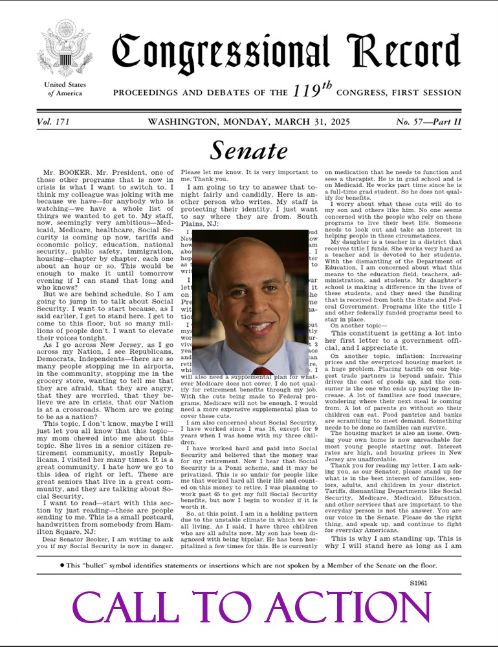
At 7:00 pm on March 31, 2025, Senator Cory Booker began a record speech against the lawless authoritarianism of the administration of President Donald J. Trump. The speech was the longest in the history of the US Senate, twenty-five hours and five minutes, exceeding the previous record of Senator Strom Thurmond, who had filibustered the Civil Rights Act of 1957. Ironically, a black man had risen to become a senator and to defeat that ignominious record. The purpose of this display, entirely performative but also extraordinary and meaningful, was to awaken Americans to the dangers to democracy and the country of the actions by the Trump administration.
The speech was technically not a filibuster, although it gave every appearance of one. Senator Booker held the floor in the same manner and under the same rules, but he was not blocking any vote or pending business.
Many of Senator Booker’s Democratic colleagues assisted by asking long rhetorical questions, elucidating many issues afflicting their constituents. Senator Booker read many messages from constituents and quoted many articles at length as exposition of problems and fears and discussion of Democratic solutions.
While the speech was partisan, it was reasonable and invited Republican cooperation, which is unlikely at this time of writing, less than a month later. Senator Booker complained mightily about the lack of interest in oversight by Republican members of Congress to check the President’s outlandish behaviors.
There was not much filler for a speech of this kind. The senators had coordinated to form many cogent and compelling arguments. Most enjoyable was the energy and passion of Senator Booker, and the humor of the presentation; for, although the senators were addressing the most serious dangers to our democracy, they were aware also of the futility of trying to restrain an autocrat with a good speech. In spite of the high expectation of failure, the senators admirably gave their most earnest efforts, hoping to gain the attention of the American people and to encourage them to protest and resist.
I had seen portions of the speech on video, and the video is available online. However, reading the speech is a very different experience and engages us more analytically in the substance of the argument. The speech as a whole is a wonderful work of political art.